
Why Air Fryers Cook Food Faster Than Conventional Ovens Do
Air fryers cook food faster than conventional ovens by combining a more powerful fan with a much smaller cooking chamber, which forces hot air to circulate up to ten times faster and hit food surfaces instantly. This high-speed convection transfers heat more efficiently, cutting overall cooking time by 20 to 30 percent while also reducing preheating to nearly zero. The compact design not only speeds up cooking but also uses less electricity, making the air fryer a faster and more energy-efficient option for everyday meals.
An air fryer is a small countertop appliance that cooks food by circulating hot air at high speed. It works like a convection oven but uses a more powerful fan in a much smaller chamber.
Quick Verdict: Air fryers cook food faster than conventional ovens because they combine intense forced convection with a compact cooking space. The high-speed fan blasts hot air directly onto the food, transferring heat more efficiently. This reduces preheating time and cooks food up to 30% faster while using less energy.
Key Takeaways
- Air fryers use a high-speed fan to circulate hot air at speeds up to 10 times faster than a conventional oven, which speeds up cooking time.
- The small cooking chamber (typically 3 to 12 liters) means the hot air reaches all surfaces of the food almost instantly, eliminating long preheating waits.
- Food cooks 20% to 30% faster in an air fryer compared to a conventional oven, according to the.
- Air fryers also use less electricity because they heat a smaller volume of air and maintain temperature more efficiently.
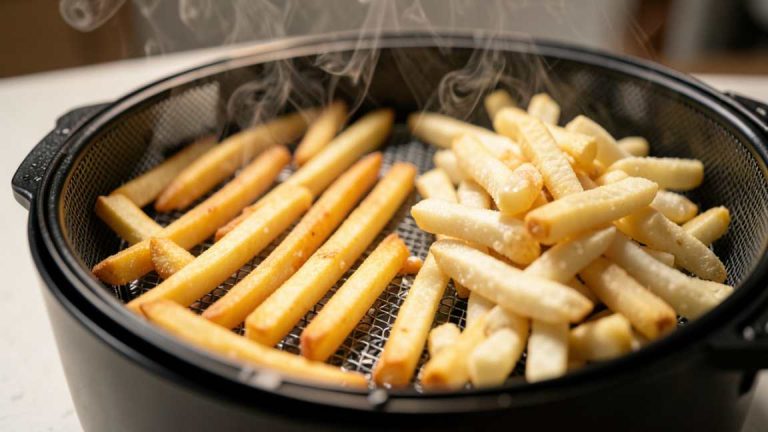
- The intense air circulation creates a crispy outer layer (Maillard reaction) faster than oven baking, reducing overall cook time for items like fries and chicken.

How Does an Air Fryer Work?
An air fryer has two main parts: a heating element and a high-speed fan. The heating element warms the air inside a sealed chamber. The fan then forces that hot air over and around the food at speeds of 50 to 100 feet per second.
This process is called convection. In a conventional oven, the fan is small and the chamber is large. The hot air moves slowly and escapes heat through the oven walls. In an air fryer, the design concentrates heat directly onto the food.
The basket or tray is also perforated. This allows hot air to flow under the food as well as over it. Every surface gets equal heat transfer, so the food cooks evenly and quickly.
Tip: Do not overcrowd the air fryer basket. Leaving space between pieces allows the hot air to circulate freely. Overcrowding blocks airflow and will slow cooking time.

Why Is an Air Fryer Faster Than a Conventional Oven?
The speed advantage comes from three factors: convection power, chamber size, and heat transfer efficiency.
1. More Powerful Convection
An air fryer fan moves air at up to 10 times the speed of a standard oven fan. According to, this rapid airflow strips away the boundary layer of cool air that usually forms on food surfaces. The hot air keeps direct contact with the food, cooking it from all angles.
2. Smaller Cooking Chamber
A conventional oven holds 60 to 100 liters of air. An air fryer holds only 3 to 12 liters. With far less air to heat, the air fryer reaches the target temperature in 2 to 3 minutes instead of 10 to 15 minutes. This alone cuts total cooking time by 5 to 10 minutes for most meals.
3. Higher Heat Transfer Rate
Heat moves faster when the air moves faster. The explains that forced convection transfers heat several times more efficiently than natural convection. In an air fryer, the coefficient of heat transfer is roughly 4 to 6 times higher than in a still oven.
Quick Comparison Table: Air Fryer vs Conventional Oven
| Feature | Air Fryer | Conventional Oven |
|---|---|---|
| Preheat time | 2-3 minutes | 10-15 minutes |
| Cooking time for frozen fries | 12-15 minutes | 20-25 minutes |
| Energy use per batch | 0.3-0.5 kWh | 0.8-1.2 kWh |
| Max temperature | 400°F (200°C) | 500°F (260°C) |
| Capacity | 3-12 liters | 60-100 liters |

Common Myths vs Facts About Air Fryer Speed
Many misconceptions surround why air fryers are faster. Let us set the record straight.
Myth 1: Air fryers cook faster because they reach higher temperatures.
Fact: Most air fryers max out at 400°F, while conventional ovens can go to 500°F. The speed advantage comes from rapid air movement, not higher heat. The notes that forced convection at moderate temperatures can cook food more quickly than still air at higher temperatures.
Myth 2: Air fryers actually fry – that is why they are fast.
Fact: Air fryers do not submerge food in oil. They use a thin coating of oil and rely on hot air circulation to create a crispy texture. The speed comes from the convection, not from oil. In fact, deep frying is faster than air frying because oil transfers heat even more efficiently than air.
Myth 3: Air fryers cook all foods the same amount faster.
Fact: Cooking time reduction varies by food type. Thin, high-surface-area foods like french fries and chicken wings see the biggest speed boost – up to 30% faster. Dense items like whole chickens or roasts may only cook 10-15% faster because the heat must still penetrate the interior.

Pro Tips for Faster Air Fryer Cooking
Get the most speed from your air fryer with these practical tips.
- Preheat the air fryer for exactly 3 minutes before adding food. This ensures the chamber is at optimal temperature from the start.
- Cut food into smaller, uniform pieces. Thinner pieces allow the hot air to cook them faster and more evenly.
- Pat food dry before adding oil. Excess moisture creates steam, which slows the Maillard reaction and adds time.
- Use a light spray of oil – about 1 to 2 tablespoons per batch. Too much oil creates grease that reduces airflow efficiency.
- Shake or flip food halfway through cooking. This repositions every piece into the hot air stream, preventing cold spots.
Warning: Never fill the basket more than two-thirds full. An overloaded basket blocks airflow and can increase cooking time by 50% or more. It also leads to uneven results.
What Affects Air Fryer Speed?
Several variables influence how much faster an air fryer performs compared to an oven.
- Food density and moisture: Frozen foods take longer than thawed ones because melting ice absorbs heat.
- Basket material and design: Dark, nonstick baskets absorb heat faster than shiny metal ones, slightly speeding up cooking.
- Brand and fan power: Models like Ninja and Cosori often have high-wattage fans (1500-1800W) that move air more aggressively than budget models.
- Altitude: At higher elevations, air is thinner and heat transfer is less efficient. Cooking times may increase by 5-10%.

How to Adjust Oven Recipes for Air Fryer
Converting a conventional oven recipe to air fryer is simple. Follow these steps to maintain the speed advantage.
- Reduce the temperature by 25°F. For example, if the oven recipe says 400°F, set the air fryer to 375°F. The intense convection can scorch food at full heat.
- Reduce cooking time by 20-30%. Check food at the two-thirds mark and adjust from there.
- Cut food into smaller portions than the recipe calls for. This allows the air to reach every piece quickly.
- Use a thin layer of oil – brush or spray, never pour.
Important: For recipes that require a lot of liquid (like braised meats or casseroles), an air fryer is not a good substitute. Liquid prevents the hot air from creating a crispy crust and slows evaporation. Use the oven for those dishes.
Frequently Asked Questions
Why does an air fryer cook frozen food faster than an oven?
Because the high-speed fan blasts hot air directly onto the frozen surface, melting ice and cooking the food at the same time. In a conventional oven, the cold food depresses the temperature of the large air volume, requiring a longer recovery time.
Can I use my air fryer to replace my oven entirely?
Not completely, because most air fryers are too small for large items like whole turkeys or multiple trays of cookies. However, they can replace the oven for most single-serving or small-batch cooking, often cutting total time in half.
Does preheating really save time in an air fryer?
Yes. According to, preheating an air fryer for 2-3 minutes reduces total cooking time by up to 10% compared to a cold start. The hot chamber starts cooking food instantly.
Are air fryers more energy-efficient because they are faster?
Yes. The Department of Energy reports that an air fryer uses about 30-40% less electricity than a conventional oven for the same batch of food, due to smaller volume and shorter cooking time.
What is the Maillard reaction and how does air frying speed it up?
It is the chemical reaction between amino acids and sugars that creates browning and flavor. The high-speed hot air removes moisture from the food surface rapidly, allowing the Maillard reaction to begin at a lower temperature and finish much faster than in a conventional oven.

Resources and Tools
- USDA Food Safety and Inspection Service – Guidelines for cooking times and safe minimum temperatures.
- Consumer Reports Air Fryer Ratings – Tested fan speeds, cooking times, and energy use for popular models.
- AirFryerCalculator.com – Online tool that converts oven recipes to air fryer times and temperatures.
- Ninja Air Fryer App – Free recipe collection optimized for convection cooking speeds.
Final Thoughts
Air fryers cook food faster than conventional ovens because they combine small chambers with powerful fans that force hot air directly onto every surface. This reduces preheating to under three minutes and cuts cooking time by up to 30 percent. Choose the right recipe adjustments and avoid overcrowding to get the best speed and texture every time.