How Altitude Changes Pressure Cooking Times in Your Kitchen
Altitude changes pressure cooking times because lower atmospheric pressure at higher elevations reduces water’s boiling point, causing a pressure cooker to reach a lower internal temperature even at the same gauge pressure. To compensate, cooking times must be increased by roughly 5 to 20 percent for every 1,000 feet above sea level, with larger adjustments needed for dense foods such as dried beans and whole grains. Applying this altitude-specific time increase ensures food cooks safely and thoroughly, preventing the common problems of undercooked meat, hard beans, and unevenly cooked rice.
You moved to a mountain town and your trusty pressure cooker now leaves beans hard and meat tough. You did not change your recipe, but the altitude did.
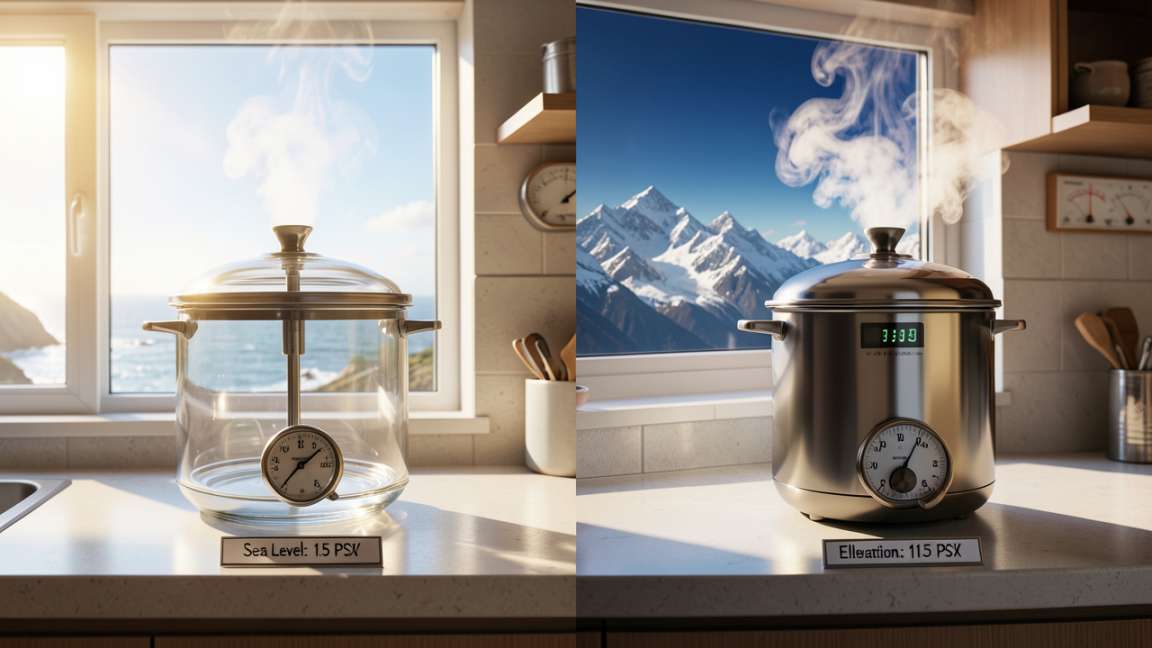
Simply put, as altitude increases, air pressure drops. This lowers the boiling point of water. A pressure cooker relies on building high internal pressure to raise that boiling point. At higher altitudes, the maximum pressure inside the cooker stays the same, but the starting point (ambient pressure) is lower. This changes the final cooking temperature and the time required to cook food safely and properly.
What Happens to Water at High Altitudes
Water normally boils at 212°F (100°C) at sea level. At 5,000 feet, it boils at approximately 202°F. At 7,500 feet, it drops to around 198°F.
This lower boiling point means food cooks more slowly in regular pots. A pressure cooker solves this trap. It seals steam inside, forcing the internal pressure to rise well above ambient levels. This pushes the boiling point back up typically to 240-250°F.
The issue is subtle. At sea level, a cooker reaches an internal pressure of about 15 psi above ambient. At 5,000 feet, that same 15 psi above ambient creates a different final temperature. According to, the temperature inside a pressure canner at 15 psi drops about 2°F for every 1,000 feet of elevation gain.
This gap creates the need for adjusted cooking times. You must cook longer to achieve the same internal food temperature and texture.
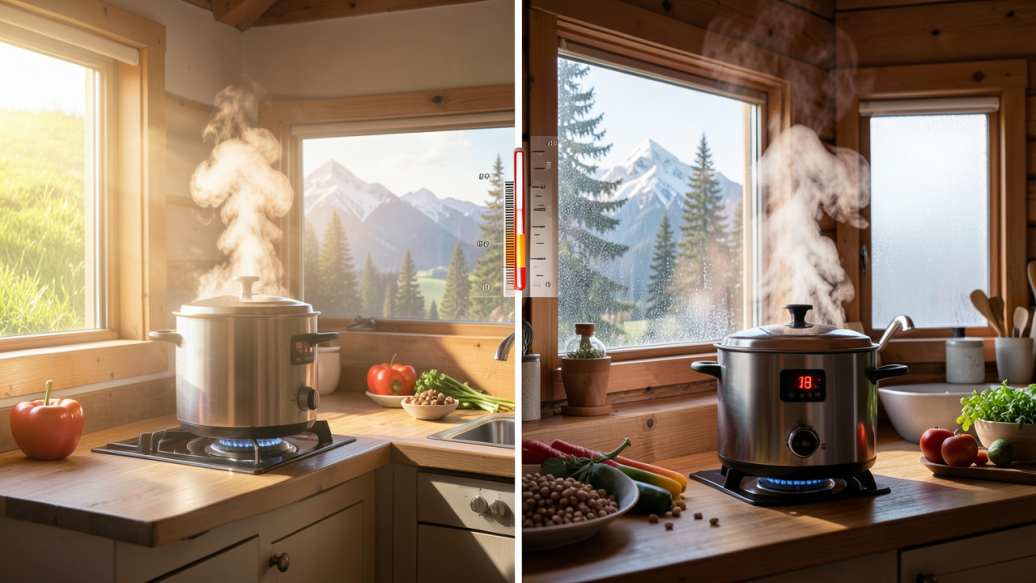
How to Adjust Pressure Cooking Times for Altitude
Most pressure cooker manuals include a simple altitude adjustment chart. If you do not have yours, follow this standard guideline.
For every 1,000 feet above 2,000 feet of elevation, increase cooking time by approximately 5 percent. This rule applies to both stovetop and electric pressure cookers.
Altitude Adjustment Table
| Altitude (Feet) | Sea Level Time | Adjusted Time (5% per 1000 ft) |
|---|---|---|
| 2,000 ft | 30 minutes | 30 minutes (no change) |
| 3,000 ft | 30 minutes | 32 minutes |
| 5,000 ft | 30 minutes | 35 minutes |
| 7,000 ft | 30 minutes | 38 minutes |
| 10,000 ft | 30 minutes | 45 minutes |
Warning: Do not simply add 5 minutes across all recipes. Always use the percentage method. A 15-minute recipe at sea level only needs 17 minutes at 5,000 feet. A 60-minute recipe needs 69 minutes at the same altitude.
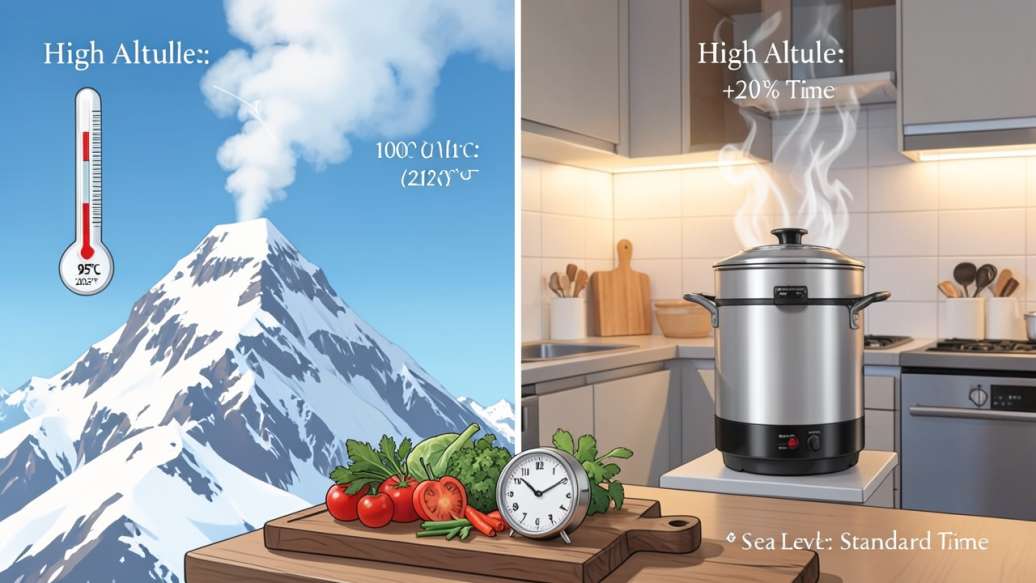
Key Takeaways for High Altitude Pressure Cooking
- Increase pressure cooking time by 5 percent for every 1,000 feet above 2,000 feet of elevation to compensate for lower ambient pressure and reduced final cooking temperature.
- Your pressure cooker still reaches its target psi, but the maximum internal temperature drops by approximately 2°F per 1,000 feet of elevation gain.
- Foods that absorb water, especially dried beans and grains, require both longer cooking time and additional liquid to hydrate properly at high altitude.
- Always test doneness using a fork or food thermometer after the adjusted minimum cooking time before assuming food is safe to eat.
- Electric pressure cookers and stovetop models both require the same percentage-based time adjustments at altitude.
How Does Altitude Affect Different Foods?
Not all foods react the same way to reduced pressure and temperature. Some types of food need larger adjustments than others.
Dried Beans and Legumes
Beans absorb water slowly at high altitude. The lower cooking temperature means the starches take longer to soften. A recipe for pinto beans that takes 25 minutes at sea level needs 30 minutes at 5,000 feet and up to 35 minutes at 7,000 feet.
Soak dried beans overnight before pressure cooking. This reduces total cook time and reduces the risk of undercooked centers.
Meat and Poultry
Meat responds predictably to time adjustments. Braised cuts like pot roast or pork shoulder benefit from the longer cook time. The extra minutes break down collagen more fully, often producing more tender results than at sea level.
Use an instant-read thermometer to check internal temperature. Ground meats need to reach at least 160°F. Poultry requires 165°F. Do not rely solely on time for safety.
Rice and Grains
Grains cook differently at high altitude. The lower boiling point slows starch gelatinization. Brown rice takes significantly longer than white rice. Use the same 5 percent rule but also add 10-15 percent more liquid to account for faster evaporation during the warmup phase.
Vegetables
Most vegetables cook quickly anyway. At high altitude, root vegetables like potatoes and carrots need the full adjustment. Delicate vegetables like broccoli and green beans need only minimal increases of 5-10 percent.
Common Mistakes to Avoid When Pressure Cooking at High Altitude
- Do not assume electric pressure cookers compensate automatically. Most models do not adjust cooking time based on altitude. You must set the time manually.
- Do not skip adding extra liquid. At high altitude, liquid evaporates faster during the preheating phase. Add at least ¼ cup additional water or broth beyond the recipe requirement.
- Do not open the pressure cooker early to check doneness. Each release and repressurization cycle adds significant time and alters the cooking profile.
- Do not trust the natural release timing from sea-level recipes. Natural release cools the pot slowly, which continues cooking food. At altitude, the same natural release period may not be long enough.
- Do not ignore your specific pressure cooker model manual. Some manufacturers provide unique altitude guidelines for their specific product lines.
Tip: If you are cooking or canning at an elevation over 6,000 feet, consider purchasing a pressure canner with a weighted gauge. Weighted gauges are less sensitive to altitude fluctuations than dial gauges and require simpler adjustments.
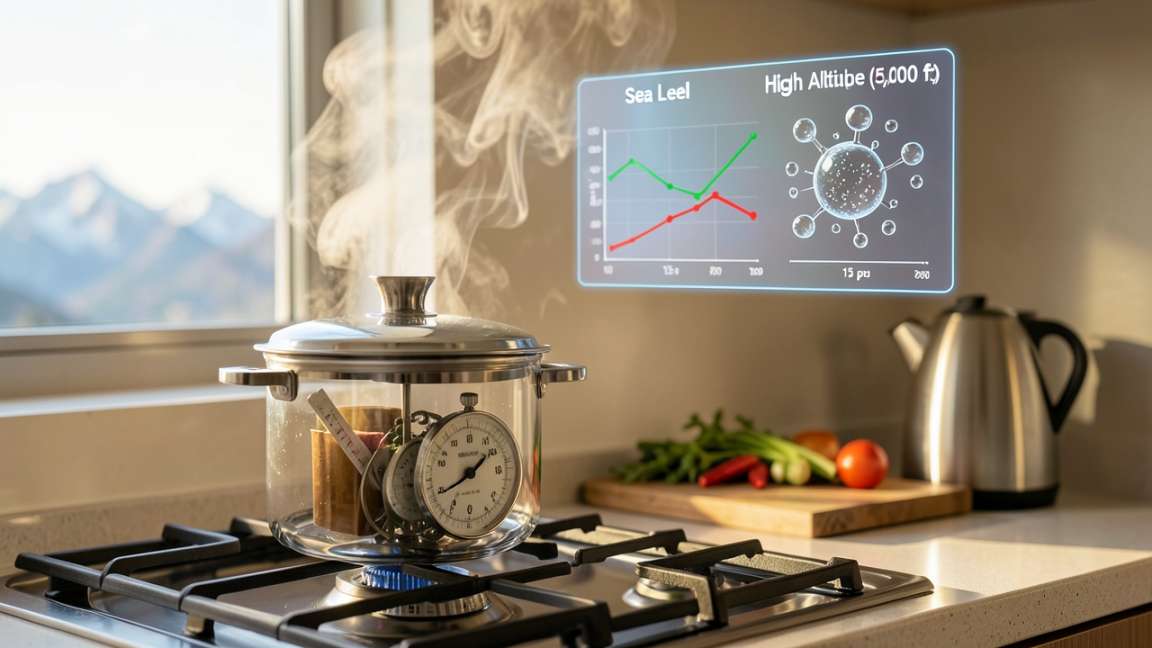
What Is the Science Behind Pressure Cooking at Altitude?
A pressure cooker works by trapping steam. As the liquid inside heats, it produces vapor. The sealed lid prevents that vapor from escaping. Pressure builds, which raises the boiling point of the liquid.
At sea level, standard atmospheric pressure is 14.7 psi. A typical pressure cooker adds 10 to 15 psi of additional pressure. This brings the total internal pressure to about 25-30 psi. The boiling point rises to approximately 240-250°F.
At 5,000 feet, atmospheric pressure is around 12.2 psi. Your cooker still adds the same 15 psi. The total internal pressure is now about 27 psi. The difference seems small, but the boiling point only rises to about 236°F at that total pressure. That is a 10-14°F drop compared to sea level.
According to the, every 1°F drop in cooking temperature adds approximately 2-3 minutes of required cooking time for dense foods. This cumulative effect explains why a 5 percent time increase per 1,000 feet is the standard recommendation.
Pressure Canner vs Pressure Cooker at High Altitude
Canning at high altitude requires stricter adjustments than everyday cooking. The risk of food spoilage increases if the internal temperature does not reach safe levels.
A pressure canner must reach 240°F to kill Clostridium botulinum spores. At high altitude, you cannot assume your canner reaches that temperature even at 15 psi. You must process according to altitude-adjusted times provided by authoritative sources.
| Pressure Type | Sea Level | 2,001-4,000 ft | 4,001-6,000 ft | 6,001-8,000 ft |
|---|---|---|---|---|
| Dial Gauge | 11 psi | 12 psi | 13 psi | 14 psi |
| Weighted Gauge | 10 psi | 15 psi | 15 psi | 15 psi |
This table is from. Always refer to their latest canning guidelines for your specific altitude and pressure canner model.
Common Myths About High Altitude Pressure Cooking
- Myth: Electric pressure cookers automatically adjust for altitude. This is false. Most electric pressure cookers have no sensor for atmospheric pressure. You must manually adjust the timer as you would for a stovetop model.
- Myth: You do not need to adjust time if you use high pressure mode. This is false. High pressure mode still operates within the same physical limits. The temperature inside the cooker drops at altitude regardless of the pressure setting.
- Myth: Adding more liquid solves the problem. This is partially false. Extra liquid prevents burning and dry-out, but it does not raise the internal temperature. You still need longer cooking times.
Frequently Asked Questions
Do I need to adjust both pressure and time at high altitude?
You only need to adjust time, not pressure. Your pressure cooker still reaches its designed psi. The issue is the lower starting temperature and final cooking temperature. Time adjustments account for this.
What is the best pressure cooker for high altitude kitchens?
Stovetop models with weighted pressure regulators offer the most consistent performance at high altitude. Brands like and manufacture models with clear altitude guidance. Electric models like the work well but require manual time adjustments.
How does altitude affect natural vs quick pressure release?
Natural release takes longer at high altitude because the ambient pressure is lower. The pressure differential between the cooker and the kitchen air is smaller, so steam escapes more slowly. Expect natural release to take 20-30 percent longer than sea level recipes indicate.
Can I use a sea level pressure cooker recipe without changes at 5,000 feet?
No. You risk undercooked food and potential food safety issues. Add 5 percent cooking time per 1,000 feet above 2,000 feet. For a 30-minute recipe at 5,000 feet, cook for 35 minutes. Always check food temperature and texture before serving.
What happens if I undercook food at high altitude in a pressure cooker?
Undercooked beans remain hard and may cause digestive discomfort. Undercooked meat or poultry can contain harmful bacteria. At high altitude, the lower temperature inside the cooker may not be sufficient to pasteurize food fully. Always err on the side of longer cooking times and verify doneness.
Resources and Tools for High Altitude Pressure Cooking
National Center for Home Food Preservation – Official guidelines for pressure canning at altitude with detailed charts for all elevation ranges.
USDA Complete Guide to Home Canning – The authoritative source for safe canning practices including altitude adjustments.
Presto Pressure Cooker Manuals – Digital copies of stovetop and electric pressure cooker manuals with specific altitude adjustment tables.
Instant Pot Altitude Adjustment Guide – Official guidance from Instant Pot for their electric pressure cookers at high elevations.
Final Thoughts
Cooking at altitude requires a small but essential adjustment to pressure cooker recipes. The 5 percent rule per 1,000 feet is simple to remember and applies to nearly all foods. Electric and stovetop models both need manual time increases. With these adjustments, your pressure cooker remains a powerful tool for fast, safe, and delicious meals at any elevation.