
Recessed Vs Surface-Mounted Kitchen Lighting: Which One Should You Choose?
Choosing the right lights for your kitchen can feel tricky, especially when you first start. Many people wonder about Recessed vs Surface-Mounted Kitchen Lighting: Which One Should You Choose? It’s a common question because both options look great but work differently. Don’t worry, though!
We’ll break it all down in an easy, step-by-step way. After this, you’ll know exactly what fits your kitchen best and how to make it happen.
Key Takeaways
- Recessed lights sit inside the ceiling for a clean, modern look.
- Surface-mounted lights attach to the ceiling and can add style.
- Recessed lights offer even, general light, great for task areas.
- Surface-mounted lights can be a good choice for adding accent or decorative flair.
- Cost, installation ease, and the ceiling structure play a big role in the choice.
- Both types have pros and cons depending on your kitchen’s layout and your goals.
![Recessed Vs Surface Mounted Kitchen Lighting Which One Should You Choose[1]](https://kitchentoolslab.com/wp-content/uploads/2026/05/Recessed_Vs_Surface-Mounted_Kitchen_Lighting__Which_One_Should_You_Choose1.jpg)
Understanding Recessed Kitchen Lighting
Recessed lighting, often called can lights or pot lights, is a popular choice for kitchens. These lights are installed into a cavity in the ceiling. This means only the trim and the light bulb are visible, creating a sleek, uncluttered look.
They are great for providing general, ambient light throughout the room. Because they sit flush with the ceiling, they don’t take up any visual space, which can make a kitchen feel larger and more open.
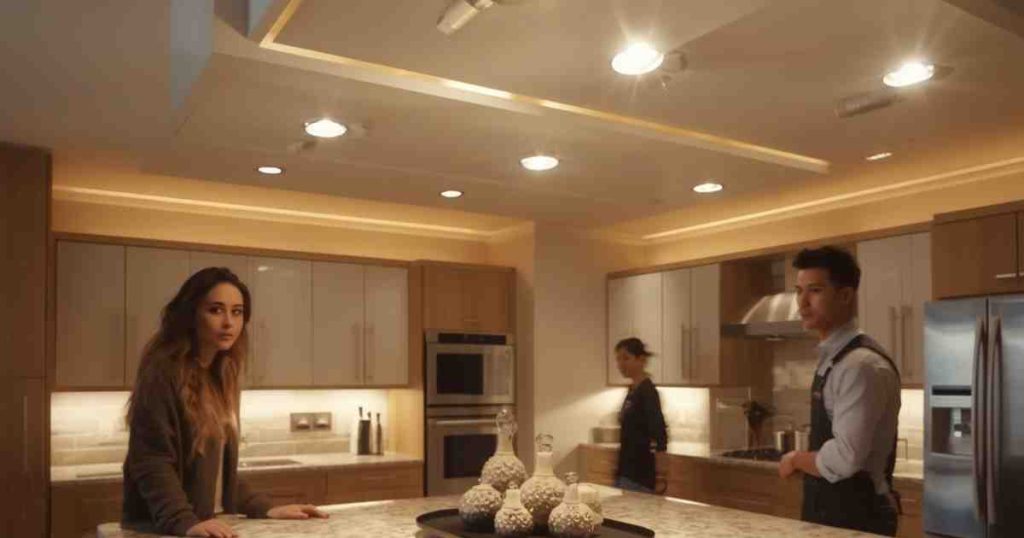
Many homeowners love them for their clean appearance and how they blend in seamlessly with any decor style.
The main purpose of recessed lights is to give off a consistent glow. They are perfect for lighting up work areas like countertops and the kitchen island. You can place them in a grid pattern to ensure no dark spots are left.
This even light distribution helps make cooking and cleaning tasks easier and safer. They are a foundational lighting element that sets the mood for the entire kitchen space.
How Recessed Lights Work
Recessed lights work by housing the light fixture and its wiring within the ceiling itself. A hole is cut into the ceiling material, and a metal or plastic housing, called a “can,” is inserted and secured. This can contains the electrical connections and acts as a barrier to prevent heat from reaching the ceiling joists.
A trim piece is then attached to the can, covering the edges of the hole and providing a finished look. The light bulb or LED module sits inside this trim.
There are a few types of housings for recessed lights. New construction housings are installed before the ceiling is put up. Remodel housings are designed for existing ceilings and can be installed from below.
IC-rated (Insulation Contact) housings can touch insulation, while non-IC-rated housings must have a small gap.
Choosing the right housing is important for safety and building codes. The type of bulb used also affects the light quality, with options like LED, incandescent, and halogen.
LED Technology in Recessed Lighting
LEDs (Light Emitting Diodes) are now the most common choice for recessed lighting. They use much less energy than traditional bulbs, saving you money on electricity bills. LEDs also last a very long time, meaning fewer replacements.
They come in many different colors of light, from warm, cozy yellow to bright, cool white. This lets you create the perfect atmosphere in your kitchen. They also produce very little heat, making them safer to use.
Another benefit of LEDs is their versatility. They can be dimmed, allowing you to adjust the brightness for different activities. You can have bright light for cooking and then dim it for a relaxed evening meal.
LEDs also come in various beam angles, which control how wide the light spreads. A narrow beam is good for highlighting specific areas, while a wide beam is better for general illumination.
Benefits of Recessed Lighting
One of the biggest benefits of recessed lighting is its clean, modern aesthetic. It provides a seamless look that doesn’t interrupt the visual flow of the room. This can make smaller kitchens feel more spacious and open.
It’s a very professional look that appeals to many homeowners. The lack of dangling fixtures also means less dust collection and easier cleaning of the ceiling area.
Recessed lights also offer excellent task lighting. When placed correctly over countertops, islands, or sinks, they provide focused light where you need it most. This improves visibility and makes kitchen tasks safer and more enjoyable.
The ability to use multiple fixtures in a grid pattern ensures even light distribution across the entire kitchen. This eliminates dark corners and creates a well-lit environment for all activities.
Improving Task Performance with Recessed Lights
Effective task lighting is crucial in any kitchen. Recessed lights, when strategically placed, can greatly improve how well you perform kitchen tasks.
For example, placing recessed lights every 2-3 feet directly over your main prep counters ensures that your own body doesn’t cast shadows while you’re chopping vegetables or measuring ingredients.
This focused illumination reduces eye strain and makes it easier to see what you’re doing, leading to fewer mistakes and a more pleasant cooking experience.
Consider a scenario where you’re trying to follow a recipe that requires precise measurements. Without adequate task lighting, it can be difficult to read small print or accurately judge quantities.
Recessed lights positioned directly above the workspace provide the bright, clear light needed for such tasks.
This not only enhances safety but also allows for a more efficient and enjoyable cooking process, especially when preparing complex meals or baking.
Potential Drawbacks of Recessed Lighting
While recessed lighting offers many advantages, it’s not without its challenges. Installation can be more involved than with surface-mounted fixtures.
It typically requires cutting holes in the ceiling and running wires, which might involve working in the attic or ceiling space.
This can be a DIY project for some, but often it’s best left to a qualified electrician, especially if you’re unsure about electrical work or if your ceiling has existing issues.
Another drawback is that recessed lights can sometimes create a “stage lighting” effect if not planned carefully.
This means light shines directly down, and if the spacing is too wide or the beam angle is too narrow, you can get harsh shadows.
Also, if your ceilings are very low, recessed lights might feel too close and create a somewhat cramped feeling.If you have beams or other obstructions in your ceiling, installing recessed lights can become more complicated.
Installation Complexity and Ceiling Considerations
The installation of recessed lighting depends heavily on your ceiling type and structure. For new homes, it’s relatively straightforward as the ceiling is not yet finished. However, in existing homes, especially with finished drywall ceilings, installation requires precise cutting and can be messy.
If you have plaster ceilings, the process is even more delicate and prone to damage.
Your ceiling joists also play a significant role. Recessed light housings are typically round and come in standard sizes. You need to ensure there’s enough space between joists to fit the housing.
If joists are too close or run in the wrong direction, you may need to use smaller housings or adjust your lighting plan.
In some cases, special “shallow” housings might be needed for low ceilings, or you might need to avoid certain areas altogether. This planning is a key part of why some people find the process challenging.
Exploring Surface-Mounted Kitchen Lighting
Surface-mounted lights are fixtures that attach directly to the surface of your ceiling. Unlike recessed lights, they don’t sit inside the ceiling cavity. This means the entire fixture is visible, offering a chance to add decorative flair to your kitchen.
These can range from simple, clean designs that blend in to elaborate chandeliers or pendants that act as focal points.
They are often easier to install than recessed lights because they don’t require cutting large holes in the ceiling.
Surface-mounted fixtures can provide general lighting, task lighting, or accent lighting, depending on their design.
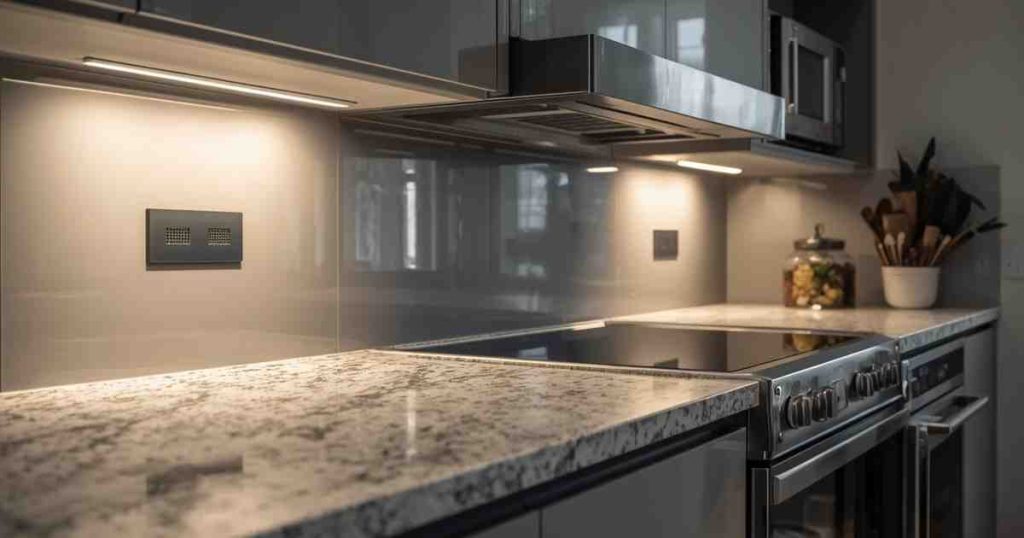
A flush-mount fixture or a semi-flush mount fixture can offer good general illumination, similar to recessed lights but with a different aesthetic.
Pendant lights or track lighting, which are also types of surface-mounted systems, can be excellent for task lighting over islands or specific work areas.
Their visibility also makes them a great way to express your personal style in the kitchen.
Types of Surface-Mounted Fixtures
There are many kinds of surface-mounted lights. Flush-mount fixtures sit directly against the ceiling, offering a low profile and good for general light in smaller rooms or kitchens with low ceilings.
Semi-flush mount fixtures hang down a few inches from the ceiling, providing a bit more visual interest and often distributing light both up and down.
They are a good middle ground between flush-mount and more decorative options.
Pendant lights are a very popular choice for kitchens. They hang down from the ceiling on a cord, chain, or rod and are often used over kitchen islands or dining areas.
They can be small and simple or large and ornate, serving as both a light source and a decorative element.
Track lighting systems consist of a track mounted to the ceiling with adjustable light heads that can be moved to direct light where needed. This offers great flexibility for lighting different areas of the kitchen over time.
Decorative Potential of Surface-Mounted Lights
Surface-mounted lights offer a fantastic opportunity to enhance your kitchen’s style. Because the fixture is visible, it becomes part of the decor. You can choose designs that complement your cabinets, countertops, and overall kitchen theme.
For instance, a modern kitchen might benefit from a sleek, minimalist track light or a geometric flush-mount fixture.
A farmhouse-style kitchen could be beautifully enhanced by a rustic pendant light with a metal finish or a fixture made of wood.
Think about how a statement pendant light above your island can draw the eye and add a touch of elegance or personality.
Or how a series of small, coordinated lights can create a cohesive look. Unlike recessed lights, which are meant to disappear, surface-mounted fixtures can actively contribute to the visual appeal of your kitchen.
They allow you to play with materials, shapes, and finishes, turning functional lighting into a design feature that truly elevates the space.
Installation and Maintenance Ease
Generally, surface-mounted lights are simpler to install than recessed lights. Since they attach to the ceiling’s surface, you don’t need to cut large holes or worry about fitting a housing into a ceiling cavity.
Most surface-mount fixtures require a simple electrical connection to a junction box already present in the ceiling.
This makes them a more accessible option for DIY enthusiasts or for quick upgrades.
Maintenance is also usually straightforward. Changing a bulb in a surface-mounted fixture is typically easier. You usually just need to remove a cover or shade, which is often held in place by screws or a simple twist mechanism.
Cleaning is also simple, as most fixtures can be wiped down easily. Because they are more accessible, keeping them looking their best is less of a chore compared to reaching up into a ceiling for recessed fixtures.
DIY Installation: A Closer Look
For many homeowners, the appeal of surface-mounted lighting lies in its potential for DIY installation. The basic process involves turning off the power to the room at the breaker box. Then, you’ll remove the old fixture if there is one.
Next, you’ll typically attach a mounting bracket to the ceiling’s electrical box. Finally, you connect the wires from the fixture to the wires coming from the ceiling (usually black to black, white to white, and ground to ground) and then secure the fixture to the mounting bracket.
While this process sounds simple, it’s important to be comfortable working with electricity. Always double-check that the power is off before you begin. If you encounter any unusual wiring or are unsure about any step, it’s always best to consult a qualified electrician.
However, compared to the extensive work of cutting holes and managing housings, surface-mount installation is often considered much more approachable for those with basic DIY skills.
Lighting Performance and Options
Surface-mounted lights can provide excellent illumination for your kitchen. Flush and semi-flush mounts are great for general ambient light, filling the room with a soft glow. Their design often allows light to bounce off the ceiling, creating a diffused and comfortable light.
This is especially beneficial in kitchens where you spend a lot of time and don’t want harsh lighting.
Pendant lights and track lights offer more flexibility for task lighting. A pendant light hung directly over a kitchen island can provide focused light for food preparation.
Track lights, with their adjustable heads, can be aimed at specific workspaces, countertops, or even decorative elements.
The type of bulb and shade used in surface-mounted fixtures also greatly influences the quality and spread of light, allowing for a customizable lighting experience.
Comparing Light Distribution: Recessed vs. Surface-Mounted
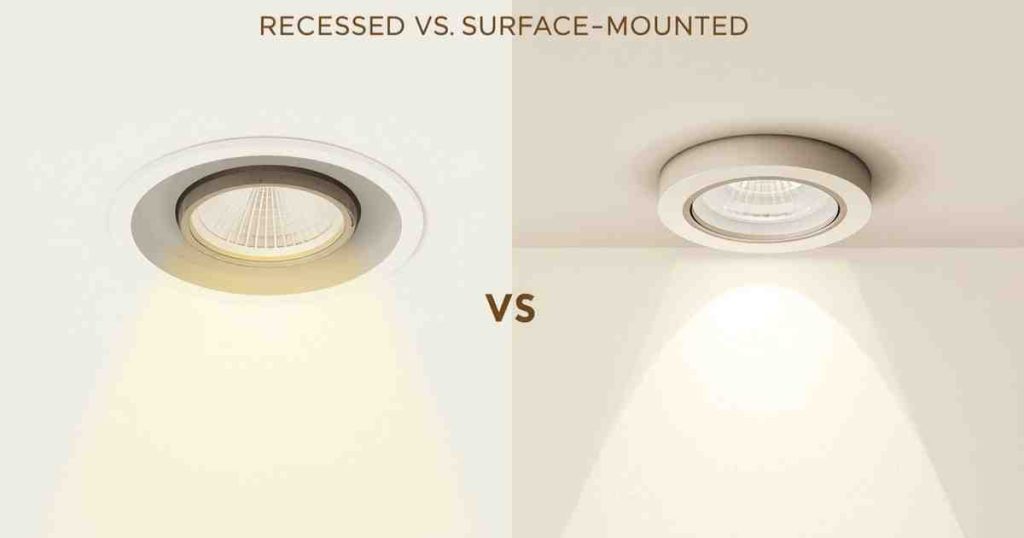
When considering Recessed vs. Surface-Mounted Kitchen Lighting: Which One Should You Choose?, light distribution is a key difference. Recessed lights typically cast light directly downwards.
When spaced correctly, this creates a very even layer of light across the entire ceiling and the space below.
However, if not planned well, they can produce harsh shadows directly under the lights. They excel at providing a uniform background light.
Surface-mounted lights, on the other hand, can distribute light in various ways. Flush and semi-flush mounts often send light upwards to bounce off the ceiling, creating a softer, more diffused ambient light. Pendant lights direct light downwards, making them excellent for focused task lighting.
Track lights are highly versatile, allowing you to aim beams precisely where needed. This means surface-mounted options can offer more specialized lighting solutions beyond just general illumination.
Making Your Choice: Recessed vs. Surface-Mounted
Deciding between recessed and surface-mounted kitchen lighting involves looking at your kitchen’s needs, your style preferences, and practical considerations like budget and installation.
There’s no single “right” answer, as the best choice depends entirely on what you want to achieve. Think about the overall look you’re going for.
Do you want a clean, minimalist feel, or do you want your lighting to be a decorative feature?
Consider how you use your kitchen. Is it a space for serious cooking and meal prep, or more of a casual gathering spot? Your answer will help determine the type of light you need.
Also, think about your ceiling. Are there any obstructions? How high are the ceilings?
These factors can make one type of lighting much more feasible or desirable than the other. Taking the time to weigh these points will lead you to the perfect lighting solution for your home.
When to Choose Recessed Lighting
You might lean towards recessed lighting if you desire a clean, uncluttered look for your kitchen. This style is perfect for modern, contemporary, or minimalist kitchens where you want the focus to be on the architecture and decor, not the fixtures. If you have a smaller kitchen, recessed lights can make it feel more spacious by not taking up visual room.
Recessed lighting is also an excellent choice for providing strong, uniform task lighting. By placing them strategically over countertops, sinks, and prep areas, you can ensure bright, shadow-free illumination for all your cooking activities.
They are ideal for creating a consistent background light that permeates the entire room, making it comfortable and safe to move around.
Ideal Kitchen Scenarios for Recessed Lights
Consider a sleek, modern kitchen with high ceilings. Recessed lighting would be a natural fit here, enhancing the clean lines and open feel of the space.
Imagine a kitchen where the homeowner wants to showcase a beautiful backsplash or a dramatic island without the visual interruption of pendant lights.
Recessed fixtures would allow these features to shine.
Another scenario is a kitchen that needs comprehensive, even lighting. If you do a lot of baking or detailed food prep, multiple recessed lights spaced evenly can provide the consistent brightness needed to work comfortably and safely.
This type of lighting is also great for kitchens that double as entertainment spaces, providing a pleasant ambiance for guests without harsh glare.
When to Choose Surface-Mounted Lighting
Surface-mounted lighting is a great option if you want your light fixtures to be a decorative element in your kitchen.
If you love a farmhouse, industrial, or traditional style, a stylish pendant or a wrought-iron fixture can add a lot of character. They are also ideal if you have low ceilings and don’t want fixtures hanging down too low.
If your ceiling structure makes recessed lighting difficult or impossible to install, surface-mounted options are a fantastic alternative. They are generally easier to install yourself, which can save on labor costs.
They also offer more flexibility in terms of where you can place them, as they don’t rely on being able to fit within ceiling joists in the same way recessed lights do.
Decorative Statement Pieces
Think about a kitchen that needs a “wow” factor. A large, ornate chandelier or a cluster of uniquely designed pendant lights can transform a plain ceiling into a work of art.
These fixtures become the focal point of the room, adding personality and style that recessed lights can’t match.
They are perfect for homeowners who see their kitchen lighting as an extension of their personal taste and interior design.
For example, a kitchen with simple white cabinets and granite countertops could be instantly elevated with a set of brushed nickel pendant lights with clear glass shades hanging over the island.
This adds a touch of sophistication and visual interest. Similarly, a rustic kitchen might feature a black metal fixture with exposed bulbs to complement wooden beams and stone accents, creating a warm and inviting atmosphere.
Combining Recessed and Surface-Mounted Lights
Often, the best lighting plan for a kitchen involves a mix of both recessed and surface-mounted fixtures.
This layering approach creates a dynamic and functional lighting scheme. You can use recessed lights for general, ambient illumination and task lighting, providing a solid foundation of light throughout the space.
Then, you can add surface-mounted lights, like pendant lights over an island or a decorative fixture in a dining nook, to add style, focus, and accent lighting.
This combination ensures that your kitchen is well-lit for all activities, from cooking and cleaning to entertaining and relaxing, while also looking beautiful.
Layered Lighting: The Best of Both Worlds
Layered lighting means using different types of lights for different purposes. Imagine a kitchen with recessed lights in the ceiling to provide even, general light.
Then, add a beautiful pendant light above the kitchen island to make it a clear focal point and provide bright task lighting for food prep.
You could also add under-cabinet lighting, which is another form of surface-mounted accent lighting, to brighten your countertops.
This approach ensures that every area of your kitchen is well-lit and functional. You can dim the recessed lights for a softer ambiance in the evening and keep the pendants bright for cooking. This flexibility makes the kitchen a more enjoyable and practical space.
It also allows you to highlight different features of your kitchen at different times.
Installation and Cost Factors
When comparing Recessed vs. Surface-Mounted Kitchen Lighting: Which One Should You Choose?, it’s important to consider the practical aspects of installation and overall cost. Recessed lighting generally involves a higher upfront cost.
This is due to the need for more specialized labor if hiring an electrician, the cost of the housings, and potentially more complex wiring.
Surface-mounted lighting, on the other hand, can often be a more budget-friendly option. The fixtures themselves can be less expensive, and the simpler installation process can reduce labor costs.
However, the final price tag will always depend on the specific fixtures you choose, the complexity of your kitchen’s layout, and whether you opt for professional installation or a DIY approach.
Cost Breakdown: Fixtures and Labor
The cost of recessed lighting fixtures themselves can vary widely. Basic LED recessed trims can be relatively inexpensive, but higher-end models with advanced features can be significantly more costly. The main cost driver for recessed lighting is often the labor.
Cutting holes, installing housings, and wiring them properly can take an electrician several hours, especially in an existing home.
A rough estimate for installing a few recessed lights professionally could range from a few hundred to over a thousand dollars, depending on the number of lights and the complexity of the job.
For surface-mounted lights, the fixture cost is also a major factor. Simple flush-mount fixtures can be found for under $50, while designer pendant lights can easily cost several hundred dollars or more.
The labor cost for installing a surface-mounted fixture is typically lower than for recessed lighting because the installation is less invasive.
A DIY installation can significantly reduce costs, but if you hire an electrician, expect to pay less than for a full recessed lighting setup, perhaps $100-$300 per fixture depending on the complexity.
Sample Cost Comparison Table
| Lighting Type | Average Fixture Cost (per light) | Estimated Installation Cost (professional, per light) | Total Estimated Cost (per light) |
|---|---|---|---|
| Recessed Lighting | $20 – $80 (LED trim) | $100 – $250 | $120 – $330 |
| Surface-Mounted (Flush/Semi-Flush) | $40 – $150 | $75 – $150 | $115 – $300 |
| Surface-Mounted (Pendant/Chandelier) | $75 – $500+ | $100 – $200 | $175 – $700+ |
This table gives a general idea, but actual costs can vary based on location, materials, and specific product choices.
DIY vs. Professional Installation
Deciding whether to install your new kitchen lighting yourself or hire a professional is a significant decision.
DIY installation of surface-mounted lights is often quite manageable for someone with basic home repair skills.
Turning off the power, connecting wires, and securing the fixture are steps that many homeowners can accomplish successfully.
This can lead to substantial savings on labor costs.
However, installing recessed lighting typically requires more expertise. It involves cutting precise holes in the ceiling, ensuring proper clearance from joists and insulation, and handling electrical connections within the ceiling space.
While some experienced DIYers might tackle this, it’s often safer and more efficient to hire a licensed electrician.
Mistakes in electrical work can be dangerous and costly to fix. For recessed lighting, professional installation is usually recommended for a safe and aesthetically pleasing result. For safe and effective results, consulting a licensed electrician is recommended for recessed lighting installation.
Safety Tips for Electrical Work
When working with any electrical fixtures, safety should always be your top priority. Before starting any installation, ensure the power to the circuit you’re working on is turned off at the main breaker box. Double-check that the power is indeed off by using a voltage tester on the wires. Always follow electrical work safety tips such as turning off power and using a voltage tester.
Never assume the power is off just because a switch is in the off position.
Always follow the manufacturer’s instructions that come with your light fixtures. If you’re unsure about any wiring connections, it’s always best to consult a qualified electrician. Improperly connected wires can lead to short circuits, fire hazards, or damage to your electrical system.
Wearing safety glasses is also a good practice to protect your eyes from dust and debris, especially when working overhead.
Frequently Asked Questions Of Recessed Vs Surface-Mounted Kitchen Lighting: Which One Should You Choose?
What is the main difference between recessed and surface-mounted lighting?
Recessed lights are installed inside the ceiling, so only the trim and bulb are visible, creating a clean look. Surface-mounted lights attach to the outside of the ceiling and are fully visible, often adding decorative style.
Which type of lighting is better for a small kitchen?
Recessed lighting can make a small kitchen feel more spacious because it doesn’t take up visual room. However, well-chosen surface-mounted fixtures, like a simple flush mount, can also work well without overwhelming the space.
Can I mix recessed and surface-mounted lights in my kitchen?
Yes, mixing them is very common and often recommended. You can use recessed lights for general illumination and task lighting, and then add pendant lights or decorative fixtures for style and accent.
Which type of lighting is easier for a beginner to install?
Surface-mounted lights are generally easier for beginners to install. They typically don’t require cutting large holes in the ceiling and involve simpler wiring connections compared to recessed lights.
What is considered a modern look for kitchen lighting?
A modern look is often achieved with recessed lighting due to its sleek, minimalist appearance. Clean-lined surface-mounted fixtures like track lights or simple geometric designs can also create a modern aesthetic.
Final Thoughts
Choosing between recessed and surface-mounted kitchen lighting comes down to your desired look and needs.
Recessed lights offer a clean, expansive feel perfect for task lighting, while surface-mounted lights provide style and decorative flair. You can even combine both to get the best of both worlds.
Consider your ceiling, budget, and how you use your kitchen to make the best choice.

![Kitchen Lighting For Dark Countertops What Color Temperature Works Best[1]](https://kitchentoolslab.com/wp-content/uploads/2026/05/Kitchen_Lighting_For_Dark_Countertops__What_Color_Temperature_Works_Best1-768x403.jpg)
![Smart Kitchen Lighting Dimmer Switches, Motion Sensors, And App Controlled Systems[1]](https://kitchentoolslab.com/wp-content/uploads/2026/05/Smart_Kitchen_Lighting__Dimmer_Switches_Motion_Sensors_And_App-Controlled_Systems1-768x403.jpg)
![Kitchen Lighting Over Sink Best Fixture Types And Placement Rules[1]](https://kitchentoolslab.com/wp-content/uploads/2026/05/Kitchen_Lighting_Over_Sink__Best_Fixture_Types_And_Placement_Rules1-768x403.jpg)
![Statement Pendant Lights For Kitchens Trends In Brass, Black, And Mixed Metals[1]](https://kitchentoolslab.com/wp-content/uploads/2026/05/Statement_Pendant_Lights_For_Kitchens__Trends_In_Brass_Black_And_Mixed_Metals1-768x403.jpg)
![Kitchen Lighting Mistakes That Make Your Space Look Cheap (And How To Fix Them)[1]](https://kitchentoolslab.com/wp-content/uploads/2026/05/Kitchen_Lighting_Mistakes_That_Make_Your_Space_Look_Cheap_And_How_To_Fix_Them1-768x403.jpg)
![What Are The Three Layers Of Kitchen Lighting (Ambient, Task, Accent Explained)[1]](https://kitchentoolslab.com/wp-content/uploads/2026/05/What_Are_The_Three_Layers_Of_Kitchen_Lighting__Ambient_Task_Accent_Explained1-768x403.jpg)