
Vertical Storage Solutions For Small Kitchens: Maximizing Every Inch
Remember the last time you opened your kitchen cabinets and everything tumbled out? It’s a common frustration, especially when kitchen space is limited.
You want to cook, but finding a pot or a spice feels like an archaeological dig. The good news is, smart storage can transform even the tiniest kitchen into a functional and organized haven. This guide will show you how to make the most of your available space.
By implementing these ideas, you’ll spend less time searching and more time enjoying your culinary adventures, significantly boosting your vertical storage solutions for small kitchens: maximizing every inch.
Key Takeaways
- Discover innovative ways to use wall space for storage.
- Learn about clever cabinet and drawer organization hacks.
- Explore multi-functional kitchen tools and furniture.
- Understand how to declutter and maintain an organized kitchen.
- Find inspiration for stylish and practical storage solutions.
![Vertical Storage Solutions For Small Kitchens Maximizing Every Inch[1]](https://kitchentoolslab.com/wp-content/uploads/2026/05/Vertical_Storage_Solutions_For_Small_Kitchens__Maximizing_Every_Inch1.jpg)
Using Wall Space Wisely
Walls in a small kitchen are often underutilized real estate. They offer a fantastic opportunity to move items off countertops and out of crowded cabinets, making them easily accessible. Think of your walls as prime storage real estate waiting to be exploited.
This section will explore various methods to turn blank walls into functional storage hubs, helping you achieve the goal of maximizing every inch.
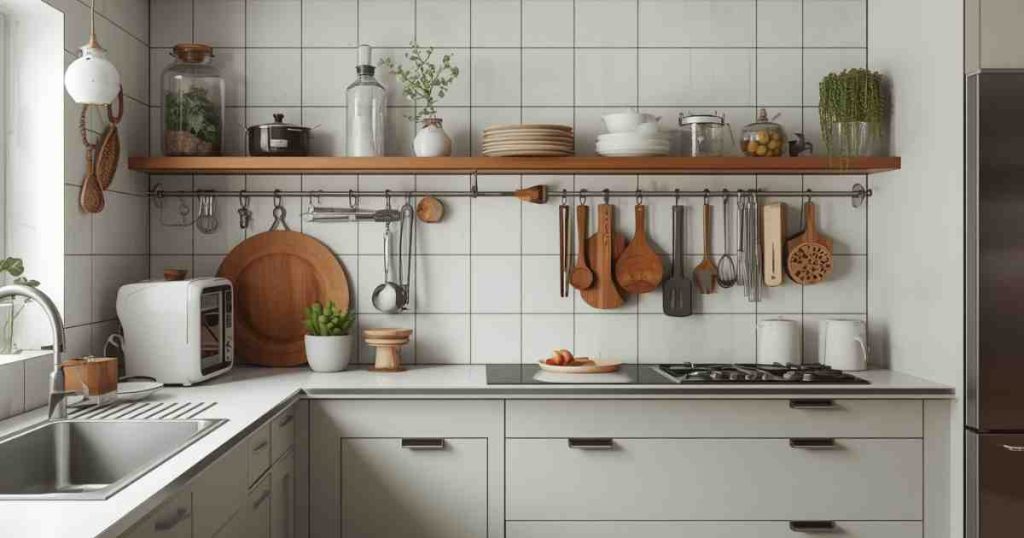
Magnetic Strips for Utensils and Knives
A magnetic strip is a simple yet incredibly effective way to store knives, metal utensils, and even spice jars with magnetic lids.
It frees up precious drawer space and keeps sharp knives safely displayed and out of reach of children. Installation is usually straightforward, often involving screws or strong adhesive backing.
The visual appeal can also be a bonus, showcasing your favorite tools.
- Knife Storage: Keep knives sharp and easily accessible, preventing accidental cuts from rummaging through drawers.
- Utensil Organization: Hang spatulas, whisks, and ladles for quick grabbing during cooking.
- Spice Rack Alternative: Attach magnetic spice tins to the strip for a colorful and organized display.
Many people find that traditional knife blocks take up valuable counter space. A magnetic strip, on the other hand, mounts directly to the wall, offering a sleek and space-saving alternative.
This not only declutters your countertops but also makes it easier to clean the surfaces beneath where the block would have been.
Some strips are designed with powerful magnets that can hold even heavy chef’s knives securely.
Floating Shelves for Open Display
Floating shelves offer a minimalist and stylish way to add storage without the bulk of traditional cabinets.
They are perfect for displaying cookbooks, decorative items, or frequently used dishes. You can install them above your sink, stove, or even in an empty corner.
The open design can make a small kitchen feel larger and more airy.
- Displaying Cookbooks: Keep your favorite recipes within easy reach while adding a decorative element.
- Storing Serveware: Place attractive serving bowls or platters on shelves for a curated look.
- Organizing Spices and Jars: Use small decorative jars to hold spices, grains, or tea, arranged neatly on the shelves.
The installation of floating shelves requires careful measurement and securing them to wall studs for adequate support.
The visual effect is one of lightness, as the shelves appear to “float” without visible brackets. This is a significant advantage in a compact kitchen where visual clutter can make the space feel smaller.
Consider the weight capacity of the shelves when deciding what to place on them.
Pegboards for Customizable Storage
Pegboards are incredibly versatile and can be customized to fit almost any storage need. You can hang pots, pans, utensils, baskets, and shelves from them, arranging them in a way that works best for you. This is a highly adaptable solution that can change as your kitchen needs evolve.
- Pot and Pan Racks: Hang cookware from hooks, freeing up cabinet space and making them easy to access.
- Utensil Holders: Attach containers or hooks to hold spatulas, spoons, and other cooking tools.
- Small Item Baskets: Use baskets to store smaller items like measuring cups, spice packets, or even small cleaning supplies.
A pegboard’s main advantage is its adaptability. You can rearrange the hooks and accessories as often as you like. This makes it ideal for dynamic kitchens where items are frequently used and put away.
For instance, during holiday baking, you might rearrange it to hold extra cookie cutters and decorating tools. The visual of a well-organized pegboard can be quite satisfying and adds a functional art element to your kitchen.
Vertical Pot Racks
Instead of stacking pots and pans, a vertical pot rack allows you to hang them. These can be freestanding units or wall-mounted.
They save space by utilizing the vertical dimension, making it easy to see and grab the pot you need without disturbing others.
- Space Saving: Reduces the need for deep cabinets by storing pots and pans in a vertical line.
- Accessibility: Each pot is visible and easy to remove without unstacking.
- Aesthetic Appeal: A well-stocked pot rack can add a professional, chef-inspired look to your kitchen.
A common complaint in small kitchens is the difficulty of storing cookware. Pots and lids often don’t stack neatly, leading to jumbled cabinets. Vertical pot racks solve this by allowing each item to hang independently.
This not only saves space but also prevents the frustration of having to dismantle a stack to get to the one pot you need. Many designs are available, from simple wall-mounted racks to more elaborate ceiling-hung chandeliers.
Hanging Spice Racks
Spice racks that hang on the inside of cabinet doors or on the wall are excellent for keeping your spices organized and accessible. This keeps them out of the way but still within easy reach when you’re cooking.
- Door-Mounted Racks: Utilize the often-wasted space on the inside of cabinet doors.
- Wall-Mounted Racks: Can be placed above the stove or on any convenient wall space.
- Improved Visibility: Allows you to see all your spices at a glance, making meal preparation quicker.
Many people have dozens of spice jars, and these can quickly clutter kitchen drawers and shelves. Hanging spice racks provide a dedicated spot for each one.
This prevents them from getting lost behind larger items and ensures you can find the exact spice you need without a prolonged search.
The visual organization can also be quite pleasing, turning a potential mess into an orderly display.
Clever Cabinet and Drawer Organization
Cabinets and drawers can quickly become black holes of clutter in a small kitchen. However, with the right tools and strategies, these spaces can be transformed into highly efficient storage areas.
This section focuses on maximizing the utility of these enclosed storage spaces, ensuring that every item has its place and is easy to find.
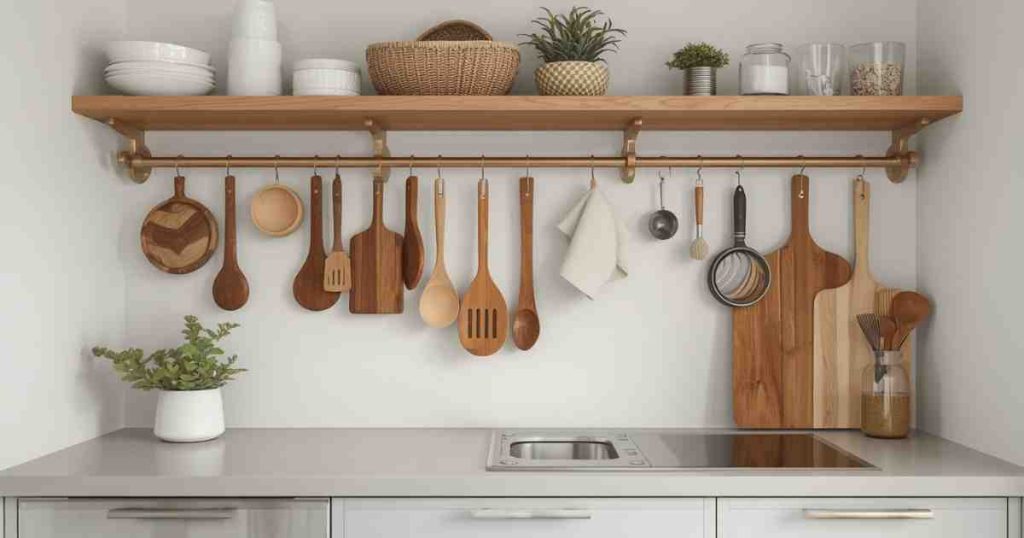
Drawer Dividers and Organizers
Drawer dividers are essential for keeping smaller items like cutlery, gadgets, and utensils sorted. Adjustable dividers allow you to customize the compartments to fit your specific needs. This prevents items from sliding around and creating a jumbled mess.
- Cutlery Organization: Keep forks, knives, and spoons neatly separated and easy to access.
- Gadget Sorting: Tidy up peelers, can openers, graters, and other small kitchen tools.
- Spice Drawer Inserts: Some dividers are designed to hold spice jars at an angle for easy viewing.
A common issue is a drawer filled with a chaotic mix of utensils and gadgets. This not only looks messy but also makes finding the right tool a time-consuming task. Drawer dividers create individual compartments, bringing order to the chaos.
Adjustable dividers are particularly useful because they can be configured to fit the exact dimensions of your drawer and the size of the items you need to store.
Cabinet Shelf Risers and Stackers
Add extra levels to your cabinets with shelf risers. These allow you to stack plates, bowls, or cans more effectively, doubling your usable storage space within a single cabinet. This is especially useful for storing items of different heights.
- Plate Stacking: Create multiple tiers for plates, allowing you to store more without excessive height.
- Can Storage: Stack cans of soup, vegetables, or drinks efficiently.
- Mug Organization: Free up space by stacking mugs on risers in a cabinet.
Kitchen cabinets often have a lot of wasted vertical space. A single shelf might have several inches of empty air above it. Shelf risers, also known as cabinet organizers or shelf stackers, fill this gap.
They create additional levels within the cabinet, effectively doubling or even tripling the storage capacity for items like plates, bowls, mugs, and cans. This is a simple yet highly effective way to maximize vertical storage solutions for small kitchens.
Pull-Out Cabinet Organizers
These are wire or solid baskets that slide out of the cabinet. They make it easy to access items stored at the back of deep cabinets, eliminating the need to reach or unload everything. This is a particularly great solution for lower cabinets where bending and reaching can be difficult.
- Easy Access: Simply pull out the basket to reach items at the back of the cabinet.
- Reduced Strain: Eliminates the need to bend or reach into deep cabinets.
- Ideal for Pots and Pans: Makes it easy to grab heavy cookware without moving other items.
Deep kitchen cabinets can be a storage nightmare. Items at the back often get forgotten or are difficult to retrieve. Pull-out cabinet organizers, also called slide-out shelves or drawers, solve this problem.
They function like drawers within your cabinets, allowing you to slide out the entire contents. This makes accessing everything, from pots and pans to small appliances, incredibly easy and efficient.
Lazy Susans for Corner Cabinets
Corner cabinets are notoriously difficult to organize. A Lazy Susan, or turntable, spins, allowing you to easily access items stored in the back. This is perfect for spices, oils, vinegars, or cleaning supplies.
- Corner Cabinet Access: Solves the problem of hard-to-reach corners.
- Rotary Storage: Simply spin the turntable to find what you need.
- Versatile Use: Great for spices, oils, jars, or even as a small rotating countertop organizer.
The infamous “dead corner” in kitchen cabinets is a common source of frustration. Items placed there tend to be forgotten or become inaccessible. A Lazy Susan transforms this wasted space into a functional area.
By allowing you to rotate the contents, you can easily see and grab whatever you need, making the most of that tricky corner space.
Stackable Can and Bottle Organizers
These organizers are designed to hold cans or bottles in a neat, tiered fashion. They can be stacked, making them ideal for pantries or cabinets where you store beverages or canned goods. They help prevent cans from rolling around and make it easy to see what you have.
- Neat Can Storage: Keeps cans from rolling and makes it easy to see what you have.
- Bottle Organization: Holds bottles upright and prevents them from tipping over.
- Space Efficiency: Stackable design maximizes storage in cabinets or pantries.
Storing numerous cans or bottles in a small kitchen can quickly lead to disarray. These specialized organizers provide a structured way to store them.
They often feature a slope, so the cans roll forward one by one as you use them, ensuring you use older stock first.
This keeps everything tidy and makes inventory management much simpler.
Multi-Functional Kitchen Tools and Furniture
In a small kitchen, every item needs to earn its keep. This means choosing tools and furniture that can serve multiple purposes, saving space and reducing clutter.
This section explores innovative items that combine functionality, helping you create a more efficient and versatile cooking environment.
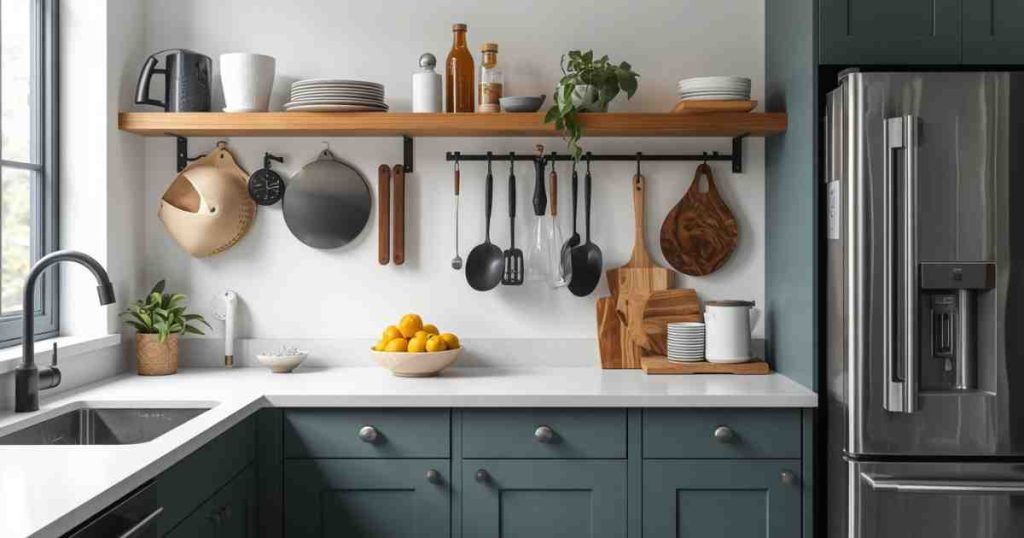
Collapsible and Nesting Cookware
Cookware that collapses or nests can save a significant amount of cabinet space. Pots and pans that fit inside each other or can be folded down are perfect for small kitchens where storage is at a premium.
- Space Saving Design: Pots and pans stack or fold to take up minimal storage space.
- Ease of Storage: Ideal for small cabinets and drawers.
- Practical for Small Households: Often come in sets suitable for one or two people.
Traditional pots and pans can be bulky and difficult to store. Collapsible or nesting cookware offers a brilliant solution. These sets are designed so that smaller pots fit inside larger ones, or they feature foldable handles.
This drastically reduces the amount of space they occupy in your cabinets, which is a major win for small kitchens. The materials are typically durable and suitable for everyday cooking.
Over-the-Sink Cutting Boards and Racks
These clever gadgets sit over your sink, extending your countertop workspace. A cutting board that fits over the sink allows you to chop food directly into a bin or compost pail, minimizing mess.
Drying racks that fit over the sink are also excellent for draining dishes without using valuable counter space.
- Extended Counter Space: Creates additional prep area without taking up permanent room.
- Reduced Mess: Chop food directly over the sink for easy cleanup.
- Dish Drying Solution: Frees up counter space by allowing dishes to dry over the sink.
The lack of ample counter space is a constant challenge in small kitchens. Over-the-sink solutions are ingenious because they utilize an area that is otherwise passive. A cutting board that spans the sink basin effectively doubles your prep area.
Similarly, a dish drying rack that hooks over the sink allows water to drain directly into it, keeping your countertops dry and clear.
Foldable and Wall-Mounted Tables
A small kitchen might not have room for a permanent dining table. Foldable tables that can be tucked away when not in use, or wall-mounted tables that fold down from the wall, offer a dining or extra prep surface without taking up permanent space.
- Space-Saving Dining: Provides a place to eat without dedicating floor space.
- Extra Prep Area: Can be folded down when needed for more cooking surface.
- Versatile Use: Doubles as a craft table or workspace.
For many, a kitchen table is a luxury they can’t afford in terms of space. Foldable or wall-mounted tables offer a practical compromise. These can be quickly deployed when you need a place to eat or a bit more room for food preparation, and then neatly folded away to reclaim valuable floor space.
This adaptability is key for making small kitchens feel more functional.
Multi-Purpose Kitchen Tools
Look for tools that do more than one job. For example, an immersion blender can blend soups directly in the pot, eliminating the need for a separate blender jar.
A mandoline slicer can julienne, slice, and dice, replacing multiple knives and cutting boards for certain tasks.
- Reduced Clutter: One tool replaces several, saving drawer and cabinet space.
- Increased Efficiency: Streamlines tasks by combining multiple functions.
- Cost-Effective: Buying fewer specialized tools can save money.
In a small kitchen, it’s essential to be selective about the tools you keep. Multi-purpose tools are a cornerstone of efficient small-space living.
Instead of having a separate gadget for every minor task, opt for items that can perform multiple functions.
This not only saves physical space but also simplifies your kitchen workflow and reduces the number of items you need to clean and store.
Decluttering and Maintaining an Organized Kitchen
Storage solutions are only effective if the kitchen is kept free of unnecessary items. Regular decluttering and establishing simple maintenance habits are crucial for ensuring that your vertical storage solutions for small kitchens remain functional and your space feels open and organized long-term.
The “One In, One Out” Rule
For every new item that enters your kitchen, try to remove one similar item. This helps prevent clutter from accumulating over time and keeps your inventory manageable.
- Prevents Overaccumulation: Stops the endless cycle of buying more than you need.
- Regular Inventory Check: Forces you to assess what you already own and use.
- Maintains Order: Helps keep cabinets and drawers from becoming overstuffed.
The "one in, one out" rule is a simple yet powerful strategy for maintaining a clutter-free kitchen. When you buy a new utensil, spice, or gadget, commit to donating or discarding an old one. This conscious decision helps you to regularly evaluate what you truly need and use, preventing the slow creep of unnecessary items that can quickly overwhelm a small space.
Regular Kitchen Purges
Schedule time, perhaps quarterly or semi-annually, to go through your kitchen. Discard expired food, broken items, duplicates, and anything you haven’t used in a year. Be ruthless!
- Removes Expired Goods: Ensures food safety and frees up pantry space.
- Identifies Underused Items: Helps you recognize what you actually need and use.
- Clears Out Duplicates: Gets rid of excess items that take up valuable storage.
Even with good habits, clutter can creep back in. Scheduling regular kitchen purges is essential for long-term organization.
This is a more thorough process than the “one in, one out” rule, involving a deep dive into your pantry, cabinets, and drawers.
Discarding expired items, broken gadgets, and things you simply don’t use anymore will create more breathing room and ensure your storage systems work effectively.
Designated Homes for Everything
Every item in your kitchen should have a designated spot. When items are returned to their “home” after use, it prevents clutter from building up on countertops and in drawers. This habit is crucial for maintaining the order you’ve created.
- Easy Retrieval: You know exactly where to find things.
- Quick Cleanup: Tidying up becomes a simple matter of returning items to their places.
- Visual Order: A kitchen where everything has a home looks and feels much more organized.
The concept of “a place for everything, and everything in its place” is fundamental to kitchen organization. Once you’ve implemented your vertical storage solutions, ensure each item has a consistent home.
This makes putting things away a mindless task, preventing clutter from accumulating on surfaces and in drawers.
It also significantly speeds up your cleanup process.
Utilize Vertical Space in Pantries
Even a small pantry can benefit from vertical storage. Stackable bins, tiered shelves, and hanging organizers can transform a cramped pantry into an efficient storage area. This maximizes the use of the entire height of the pantry.
- Maximizing Pantry Height: Makes use of the full vertical dimension of the pantry.
- Organized Food Storage: Keeps items tidy and easy to find.
- Prevents Food Waste: Well-organized pantries make it easier to see what you have before it expires.
Pantry organization is a key component of maximizing kitchen space. Many pantries, even small ones, have unused vertical space.
By using stackable containers, tiered shelves for cans, and hanging organizers for smaller items, you can significantly increase the amount of food and supplies you can store neatly.
This approach ensures that every inch of your pantry is working for you.
Sample Scenarios
Scenario 1: The Overwhelmed Cook
Sarah loves to cook but her small kitchen feels constantly cluttered. Her pots and pans are stacked precariously in a deep cabinet, and her spices are in a jumbled drawer. Countertops are always covered with gadgets and mail.
- Sarah installs a magnetic knife strip on her backsplash, freeing up a drawer.
- She adds shelf risers to her pot cabinet, allowing her to stack plates neatly and store pots more efficiently.
- A Lazy Susan is placed in her corner spice cabinet, making all her spices visible and accessible.
- She uses drawer dividers to organize her utensils and gadgets.
- Finally, she implements the “one in, one out” rule and schedules a quarterly purge to keep clutter at bay.
As a result, Sarah’s kitchen feels more spacious and functional. She can find ingredients and tools quickly, making cooking more enjoyable and less stressful.
Scenario 2: The Apartment Dweller
David lives in a compact apartment with a very limited kitchen. He needs clever storage that doesn’t require permanent modifications.
- David purchases a set of nesting cookware that stores compactly.
- He installs a tension rod inside his cabinet to hang cleaning supplies.
- He uses over-the-sink drying racks and cutting boards to maximize counter space when needed.
- He opts for a wall-mounted, fold-down table for dining and extra prep.
- He utilizes stackable bins for his pantry items.
David’s kitchen, while small, is now a highly efficient space. He can easily adapt his setup based on his needs, enjoying a more organized and usable cooking area. Readers can learn about maximizing every inch through official USDA kitchen safety guides.
Frequently Asked Questions Of Vertical Storage Solutions For Small Kitchens: Maximizing Every Inch
How can I make my small kitchen feel bigger?
Utilize vertical storage solutions like wall shelves and hanging racks to free up counter and floor space. Keep countertops as clear as possible. Using lighter colors and mirrors can also create an illusion of more space.
What is the best way to organize spices in a small kitchen?
Magnetic spice racks on walls or cabinet doors, tiered drawer inserts, or small wall-mounted shelves are excellent options. The goal is to keep them visible and easily accessible.
Should I invest in expensive storage solutions for a small kitchen?
Not necessarily. Many effective solutions are budget-friendly, such as drawer dividers, shelf risers, and pegboards. Focus on smart utilization of space rather than just the cost of items.
How often should I declutter my small kitchen?
It’s recommended to do a quick declutter weekly and a more thorough purge every 3-6 months. Establishing daily habits like the “one in, one out” rule also helps significantly.
What kind of pots and pans are best for small kitchens?
Nesting cookware sets or pots with detachable handles are ideal. They stack or fold down, taking up much less storage space than traditional sets.
Summary
Transforming a small kitchen means smart use of every available inch, especially vertically. By employing wall space, organizing cabinets efficiently, and choosing multi-functional items, you can create a highly functional cooking area. Regular decluttering ensures your systems remain effective.
Embrace these vertical storage solutions for small kitchens to maximize your space and enjoy a more organized, stress-free cooking experience.

![What Colors Make A Small Kitchen Look Larger (Designer Secrets Revealed)[1]](https://kitchentoolslab.com/wp-content/uploads/2026/05/What_Colors_Make_A_Small_Kitchen_Look_Larger__Designer_Secrets_Revealed1-768x403.jpg)
![Open Shelving In Small Kitchens Does It Actually Help Or Create More Clutter[1]](https://kitchentoolslab.com/wp-content/uploads/2026/05/Open_Shelving_In_Small_Kitchens__Does_It_Actually_Help_Or_Create_More_Clutter1-768x403.jpg)
![Small Kitchen Mistakes That Make The Space Feel Even Smaller (And How To Fix Them)[1]](https://kitchentoolslab.com/wp-content/uploads/2026/05/Small_Kitchen_Mistakes_That_Make_The_Space_Feel_Even_Smaller_And_How_To_Fix_Them1-768x403.jpg)
![Best Appliances For Small Kitchens Compact Picks That Don’T Sacrifice Performance[1]](https://kitchentoolslab.com/wp-content/uploads/2026/05/Best_Appliances_For_Small_Kitchens__Compact_Picks_That_DonT_Sacrifice_Performance1-768x403.jpg)
![Renting And Can’T Renovate Small Kitchen Design Ideas For Renters[1]](https://kitchentoolslab.com/wp-content/uploads/2026/05/Renting_And_CanT_Renovate__Small_Kitchen_Design_Ideas_For_Renters1-768x403.jpg)
![Small Kitchen Layout Ideas Which Layout Works Best For Under 100 Sq Ft[1]](https://kitchentoolslab.com/wp-content/uploads/2026/05/Small_Kitchen_Layout_Ideas__Which_Layout_Works_Best_For_Under_100_Sq_Ft1-768x403.jpg)