
Uneven Onion Dicing? Use The Grid Method To Fix Your Cuts Fast
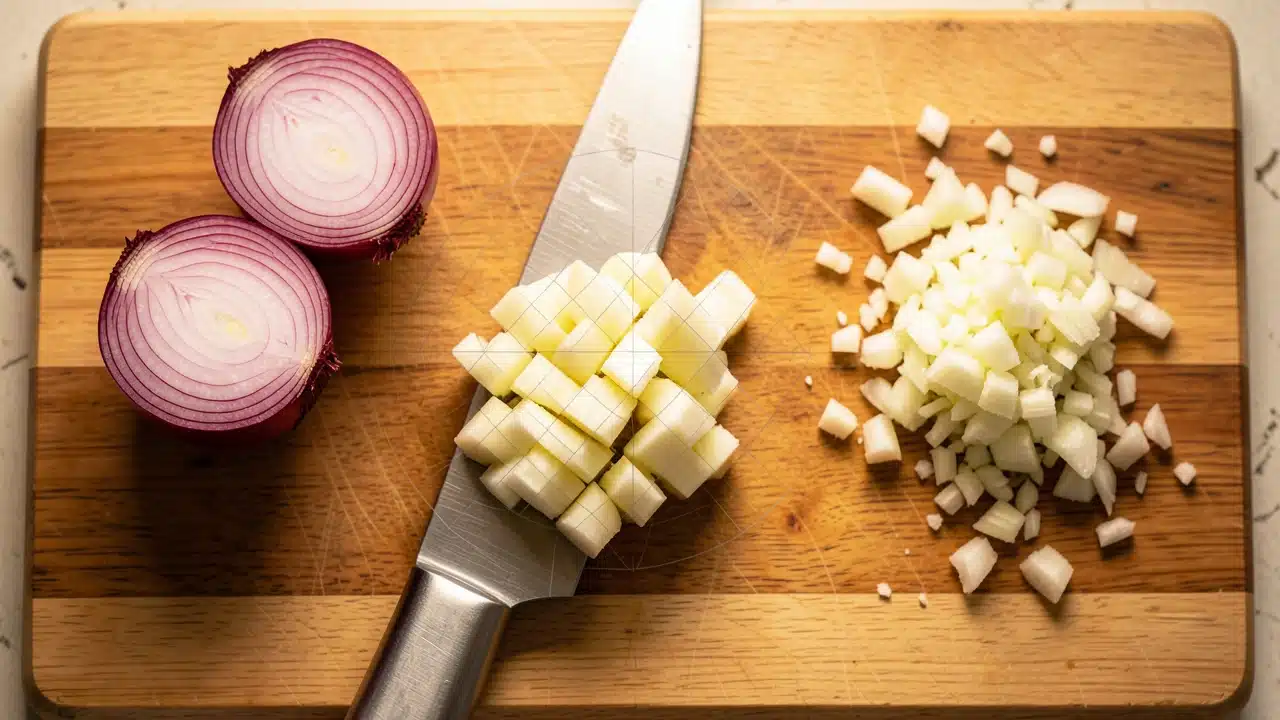
Uneven onion dicing can be fixed with the grid method: cut the onion in half, make horizontal cuts, then vertical cuts, and slice across the grid into even cubes.
Keeping the root end intact holds layers together, improves control, and speeds prep. Use a sharp knife and steady spacing for cleaner, more consistent pieces.
Tired of onion pieces that are all different sizes, making your cooking uneven? It’s a common kitchen frustration that can lead to some parts of your dish being overcooked while others are still raw. Getting perfectly uniform onion cuts makes a big difference in how your food cooks and tastes.
If you’ve been struggling with this, don’t worry! We’re going to show you how to fix it. Discover how Uneven Onion Dicing?
Use the Grid Method to Fix Your Cuts Fast can transform your chopping skills and improve your meals. Get ready to chop like a pro!
Key Takeaways
- Learn a simple technique for uniformly diced onions.
- Understand why even onion cuts are important for cooking.
- Follow easy steps to master the grid method for dicing.
- Discover how to save time and reduce frustration in the kitchen.
- Gain confidence in your knife skills for all your recipes.
- Achieve consistent cooking results with perfectly diced onions.

Why Even Onion Cuts Matter for Your Cooking
Getting your onions chopped just right is more important than you might think. When onion pieces are all the same size, they cook at the same speed. This means everything in your pot or pan gets tender at the same time.
No more biting into a crunchy piece of onion when you expected it to be soft. It also helps flavors blend better. Uniform pieces release their sweetness and aroma more evenly into your dish.
Think about a stir-fry or a soup. If your onions are uneven, some will turn mushy while others stay firm. This ruins the texture of your meal.
For dishes like French onion soup, where onions are the star, perfect dicing is key to that rich, sweet flavor. Even cuts ensure a beautiful presentation too. They make your food look as good as it tastes.

Understanding the Grid Method for Dicing
The grid method is a clever way to get perfectly diced onions every time. It’s not complicated at all. You essentially create a grid pattern on your onion before you make your final cuts.
This ensures each piece is about the same size. It’s a technique used by many chefs because it’s efficient and effective. This method helps you achieve consistent results without needing fancy tools.
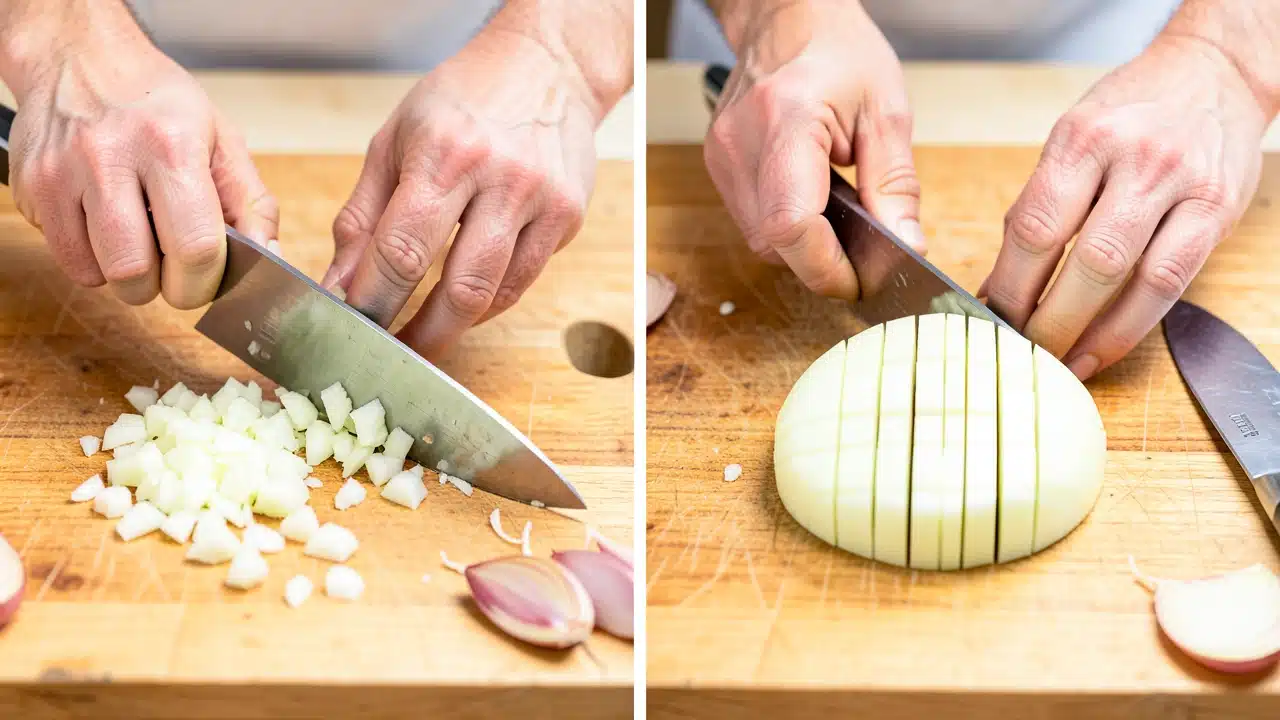
The core idea is to make horizontal cuts and then vertical cuts through the onion. This preps the onion for small, even dice. It’s a smart way to control your cuts.
Many people find this method much easier than trying to get small pieces freehand. Mastering this technique is a big step towards better cooking. It directly addresses the problem of Uneven Onion Dicing?
Use the Grid Method to Fix Your Cuts Fast.
Step-by-Step Guide to the Grid Method
Ready to try it? Let’s break down how to use the grid method for perfect onion dice. You’ll need a sharp knife and a stable cutting board.
Safety first! Always make sure your cutting board doesn’t slide around. A damp paper towel underneath can help.
Preparation is Key
First, get your onion ready. Peel off the outer dry layers. Cut off the top stem end.
Leave the root end intact for now; it holds the onion together.
Creating the Horizontal Cuts
Place the onion cut-side down on your board. Now, imagine horizontal lines going across the onion. Carefully make cuts parallel to your cutting board.
Slice through the onion, but don’t cut all the way through the root end. You want the onion halves to stay connected at the root. The number of horizontal cuts depends on the size of your onion and how small you want your dice.
For a medium onion, two or three horizontal cuts are usually enough.
Making the Vertical Cuts
Next, turn the onion so the cut side is facing you. Now, make vertical cuts. Slice downwards from the top towards the root.
Again, do not cut all the way through the root end. These cuts should be perpendicular to your horizontal cuts. Space these cuts evenly.
The spacing determines the size of your dice. Closer cuts mean smaller dice.
The Final Dicing Cuts
Then, you’re ready for the final step. Hold the onion firmly. Make cuts across the onion, perpendicular to your vertical cuts.
You’ll see small, diced pieces falling away. The horizontal and vertical cuts you made earlier guide these final cuts. This creates your grid.
The onion will naturally fall apart into uniform cubes.
Finishing Touches
Finally, discard the root end. You should have a pile of evenly diced onion. If any pieces are too large, you can simply give them another quick chop.
This method makes sure you get consistent results quickly. It’s the best way to tackle Uneven Onion Dicing? Use the Grid Method to Fix Your Cuts Fast.
Tips for Perfect Onion Cuts Every Time
Even with the grid method, a few extra tips can make your onion dicing even better. Using the right knife is crucial. A sharp chef’s knife will make clean cuts and prevent the onion from tearing.
A dull knife can smash the onion, releasing more of those eye-watering compounds.
Consider the type of onion. Yellow onions are great for general cooking. Red onions add color and a slightly sharper bite.
Sweet onions like Vidalia are perfect for caramelizing. The grid method works well for all types. Just adjust your cut spacing based on the size of the onion.
For very large onions, you might need more horizontal cuts. For small shallots, fewer cuts will suffice. Don’t be afraid to practice.
The more you dice onions, the faster and more accurate you’ll become. This method helps you achieve that perfect dice consistently.
Comparing Dicing Methods: Grid vs. Traditional
Many people learn to dice onions by simply making vertical and then horizontal cuts without pre-planning. This is the traditional method. However, it often leads to uneven pieces because it’s hard to judge size consistently.
| Uniformity of Cuts | High – Creates consistent, evenly sized pieces. | Variable – Often results in a mix of sizes. |
| Ease of Use | Easy to learn, provides a clear structure. | Can be tricky for beginners to achieve evenness. |
| Speed | Fast once mastered, efficient for large batches. | Can be slower if you’re trying to get perfect pieces. |
| Consistency | High – Reliable results every time. | Lower – Depends heavily on individual skill. |
| Frustration Level | Low – Directly solves Uneven Onion Dicing? Use the Grid Method to Fix Your Cuts Fast. | Can be high due to inconsistent results. |
As you can see, the grid method offers significant advantages. It’s a straightforward approach that guarantees better results. This makes it ideal for anyone looking to improve their kitchen skills.
It’s a simple change that makes a big difference.
Troubleshooting Common Onion Dicing Issues
Sometimes, even with the grid method, you might run into minor issues. One common problem is the onion slipping. Make sure your cutting board is stable.
You can also trim a tiny bit off the top to create a flatter surface to work on, in addition to leaving the root intact.
Another issue is getting teary eyes. While the grid method doesn’t prevent this entirely, some tips can help. Refrigerating the onion for 30 minutes before cutting can reduce the release of irritating compounds.
Cutting near a vent or fan can also help dissipate the fumes.
If your horizontal cuts aren’t quite even, don’t stress. The final vertical cuts will still create a diced shape. The key is that the overall size is reasonably consistent.
Perfect uniformity takes practice. Remember, the goal is to improve your cooking, not to achieve absolute perfection on your first try.

Beyond Dicing: Other Onion Cutting Techniques
While dicing is essential, onions are used in many ways. Understanding different cuts can broaden your culinary horizons. For example, slicing onions thinly is perfect for caramelizing or adding to sandwiches. Understanding food safety basics is important when handling onions and other produce.
You simply cut the onion in half through the root, peel, and slice horizontally from top to bottom.
For rings, you cut the onion crosswise, perpendicular to the root. This creates those familiar circular shapes. These are great for onion rings or garnishes.
Each cut serves a different purpose in cooking. Knowing these techniques complements your dicing skills.
There’s also mincing, which is like very fine dicing. You’d make smaller cuts in the grid method. Each technique requires a slightly different approach, but the foundational knife skills are similar.
Mastering the grid method for dicing is a fantastic start to becoming more comfortable with all types of onion prep. Mastering proper knife techniques is essential for safe and efficient onion dicing.
Frequently Asked Questions Of Uneven Onion Dicing? Use The Grid Method To Fix Your Cuts Fast
What is the main benefit of the grid method for dicing onions?
The main benefit is achieving uniformly sized onion pieces, which leads to more even cooking and better flavor distribution in your dishes. It directly helps with Uneven Onion Dicing? Use the Grid Method to Fix Your Cuts Fast.
How do I prevent my onion from slipping while dicing?
Ensure your cutting board is stable. You can place a damp paper towel underneath it. Also, make sure your knife is sharp for clean cuts, not tearing or smashing the onion.
Why do my eyes water when I cut onions?
Onions release sulfur compounds when cut. These compounds react with the moisture in your eyes to create sulfuric acid, which is irritating. Refrigerating the onion or cutting near a fan can help.
Can I use the grid method for other vegetables?
Yes, the grid method can be adapted for other firm vegetables like carrots or bell peppers to achieve uniform dice. The principles of horizontal and vertical cuts apply.
Is the grid method faster than traditional dicing?
Once you get the hang of it, the grid method can be faster because it pre-plans your cuts, leading to fewer wasted movements and more consistent results with each pass of the knife.
What size dice should I aim for when using the grid method?
The size of the dice depends on your recipe. You can adjust the spacing of your horizontal and vertical cuts. Closer cuts create smaller dice, ideal for sauces or delicate dishes.
Final Thoughts
Stop struggling with uneven onion pieces. The grid method is your simple solution for perfectly diced onions every time. It makes your cooking better and your time in the kitchen more enjoyable.
Practice this technique, and you’ll see a real difference in your meals.